

How Robots Help NASA In Space
By Cameron Schneider
Over the years, humans have made incredible discoveries in space. A significant factor in our advancement has been the development of robotics. Robots have played a pivotal role in helping humans learn more about space. From using robotic spacecraft to study planets far from Earth to utilizing giant robotic arms on the International Space Station, robots are fundamental in the pursuit of space advancements.
The Cassini Spacecraft: An Eye on Saturn
Robots help scientists explore planets and solar systems humans do not yet have the ability to reach.
In 1997, NASA launched the robotic Cassini spacecraft to study Saturn. The Cassini spacecraft is a complex autonomous robot, meaning it can work by itself! Using computers and powerful antennas, scientists sent commands from Earth for Cassini to complete. A great example of this is the launch of the Huygens probe in 2005. The Huygens probe, which was aboard the Cassini spacecraft when it launched, went to the surface of Saturn’s largest moon, Titan. The probe marked the first time a spacecraft landed on a moon in our outer solar system. For over a decade, the efforts of the Cassini spacecraft gave scientists unprecedented insight into Saturn and its many moons from the safety of Earth.
Astrobees: Busy Workers
Robots have been developed to help astronauts complete everyday tasks while on space missions.
 In 2018, NASA sent three colorful, cube-shaped robots named Bumble, Honey, and Queen to the International Space Station (ISS). Known collectively as Astrobees, these small, free-flying robots developed at NASA Ames were sent to help the crew aboard the ISS with routine tasks such as inventory, documenting experiments, and moving objects around the station. With the help of Astrobees, astronauts can turn their focus to other important areas of their work. Astrobees are helping to advance NASA’s goal of developing robots that will support exploration, maintenance, and monitoring in future space exploration. For NASA’s Artemis program, Astrobees are an essential factor to help deliver humans back to the Moon, to Mars, and beyond.
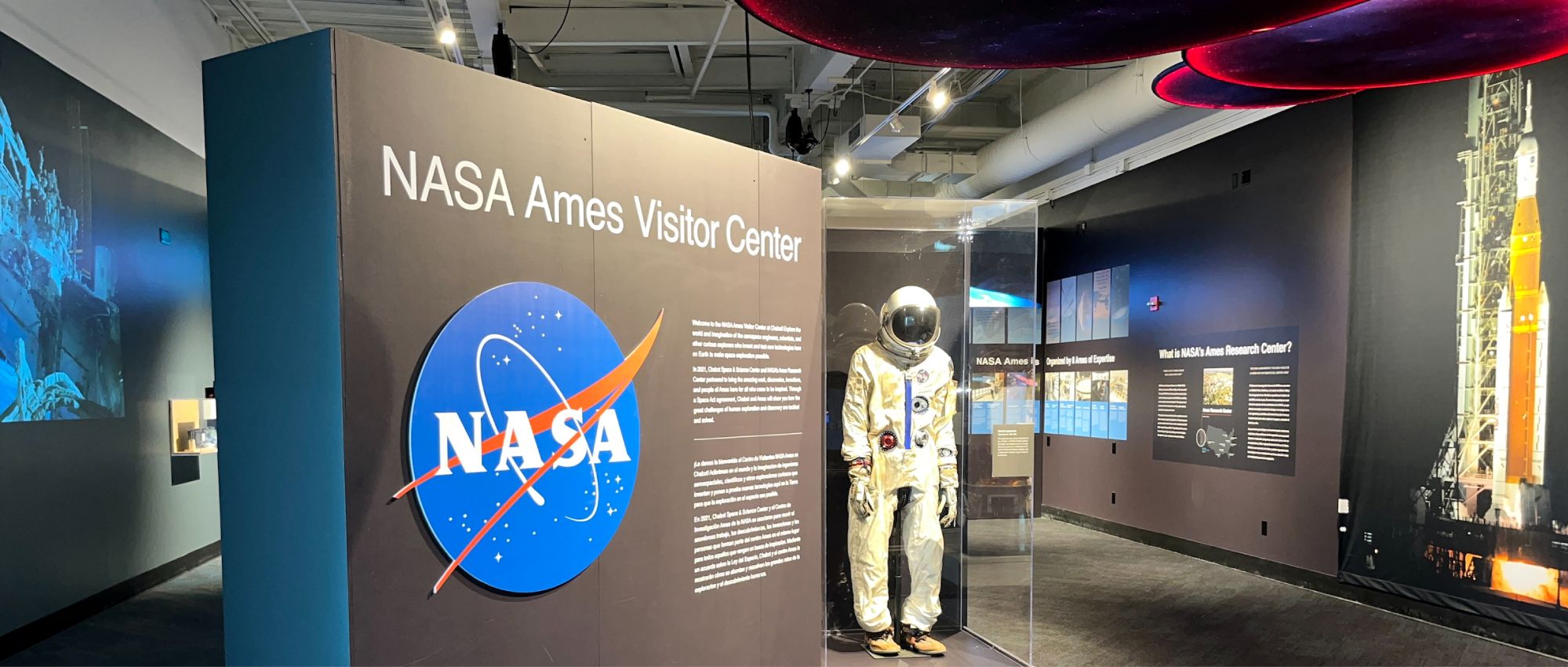
In Chabot’s NASA Ames Visitor Center, one of only 11 in the country, you can see an Astrobee that has gone to space and learn more about the research happening at NASA Ames.
Canadarm 2: A Helping Hand for Astronauts
With the help of robots, astronauts can complete tasks outside their physical capacity while in space.
Developed by the Canadian Space Agency and launched in 2001, Canadarm2 is a 57.7-foot-long robotic arm that helped with the assembly of the ISS. At both ends of this giant robotic arm are Latching End Effectors, or LEEs. The LEEs act as hands, ensuring a strong grip so the robotic arm can firmly grasp objects. With the help of Canadarm 2, parts of the ISS can be moved into place and can even move astronauts around the space station on spacewalks. This powerful tool provides those on the ISS with great strength beyond their individual ability.
The Place for Space…and Robots!
The development of robotics has been essential to our progress in space exploration. Robots have given humans the opportunity to reach farther into space than ever before. As the field of robotics evolves so too does our knowledge of space!
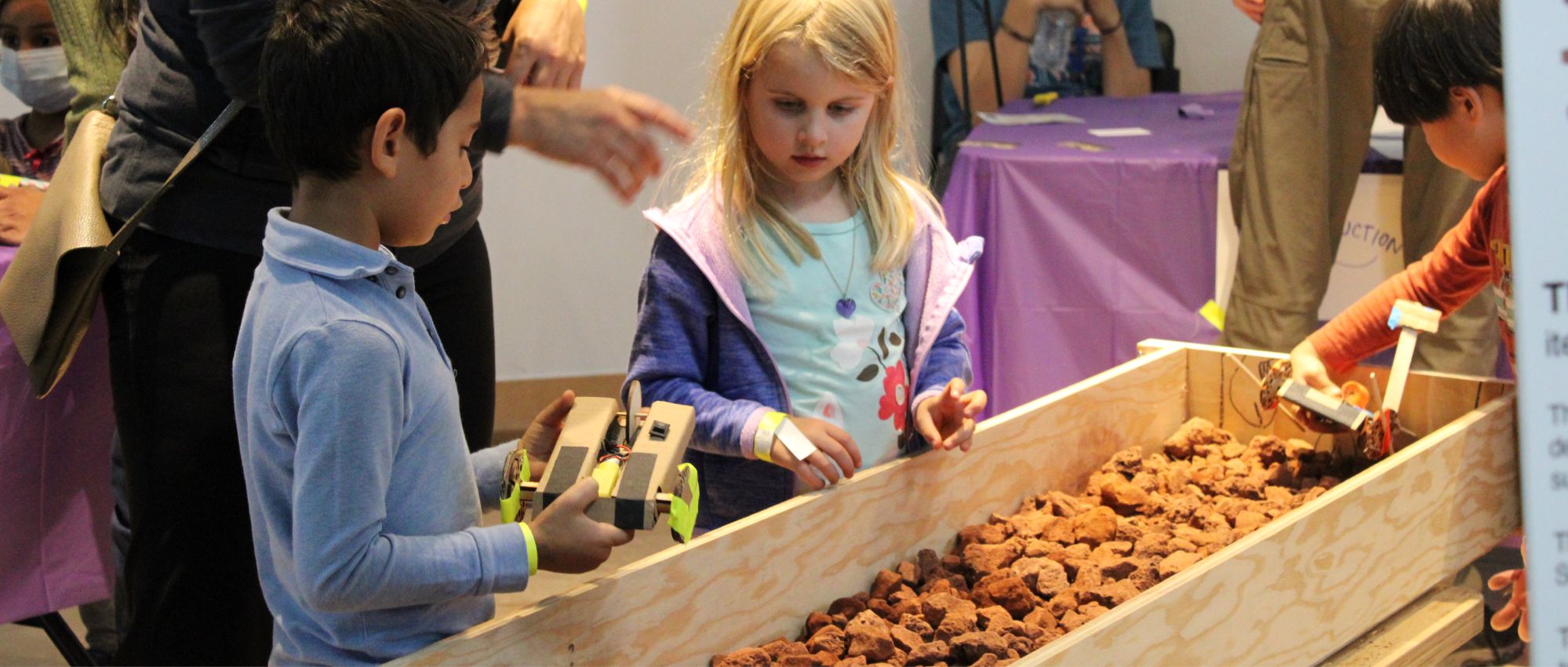
If you would like to learn more about robots, join Chabot Space & Science Center on Saturday, March 28th for Robo Expo @ Chabot! Experience hands-on exploration of robotics, featuring OUSD’s annual Robotics Club Competition and opportunities to build your own functional bots with wires, circuits and Legos! Discover more about how rovers and robots help humans make scientific discoveries out in space, tinker with tech, and get up close and personal with real aerospace robots on display in our NASA Ames Visitor Center. You may even see some familiar androids roaming the exhibits! To purchase tickets, visit chabotspace.org!


